
1 min read
The Real Cost of Keyword Blocking: Reach Lost, Dollars Wasted
In the world of digital advertising, brand safety remains a paramount concern for advertisers. With the rise of programmatic advertising and the...
2 min read
Enza Rose Yoo
:
Updated on August 4, 2026
Blocking "gaming" from a mobile app campaign feels like a safe default. It's also one of the most common blind spots in mobile in-app buying today. Advertisers who wouldn't dream of excluding all of "news" or all of "entertainment" will exclude all of "games" without a second thought, and in doing so, cut themselves off from a large share of the inventory they're trying to reach.
Mobile in-app inventory has outpaced mobile web for years, yet campaign strategies built for the web era still treat in-app as the smaller, riskier cousin. Advertisers buying mobile app inventory can't afford to treat a category this large as an afterthought, and they can't afford to block their way around it either. The apps people actually spend time in, including games, are where the impressions are.
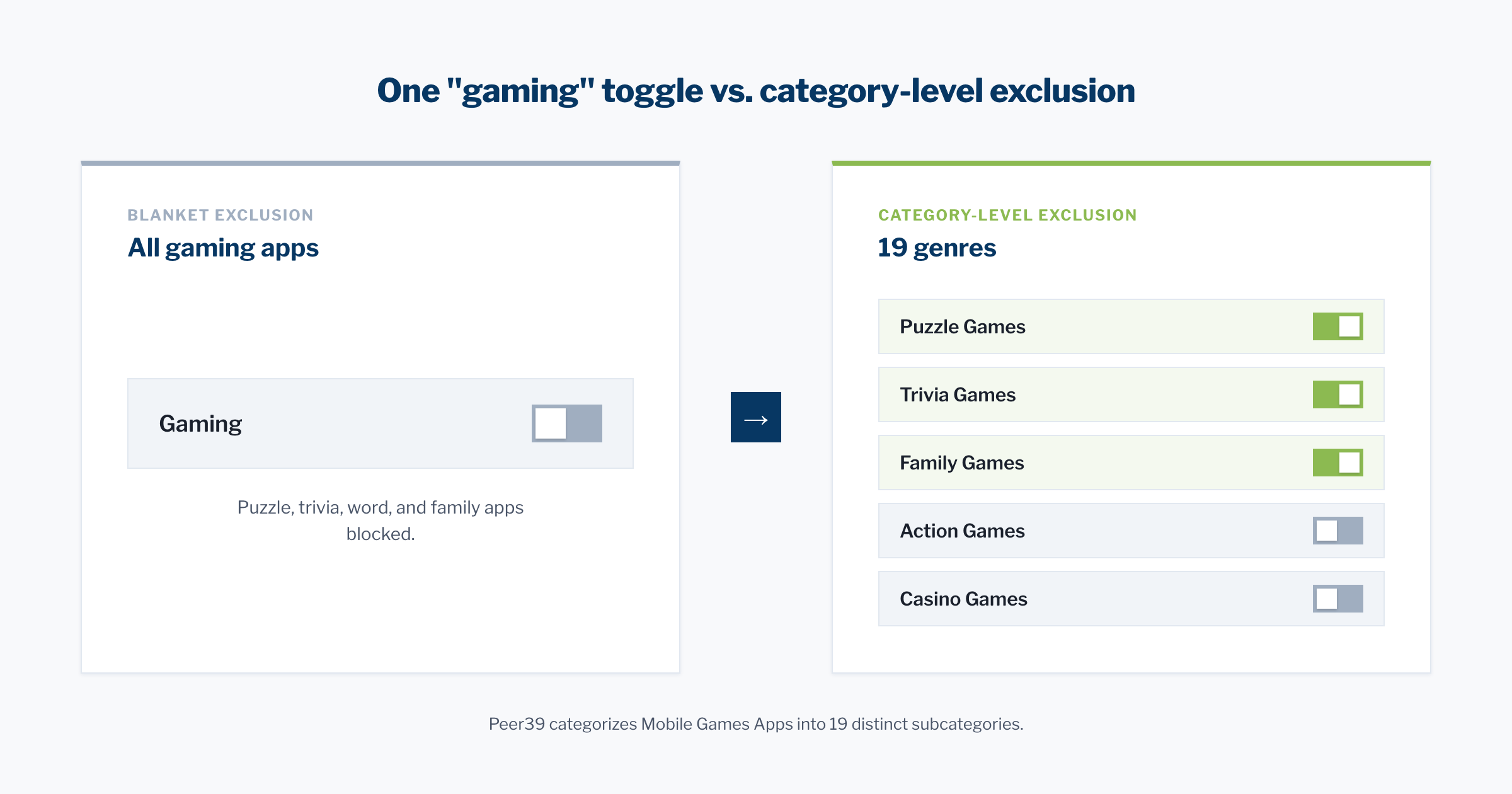
The instinct to exclude "gaming" assumes it's a single, uniform environment. It isn't. Peer39 categorizes mobile games apps into 19 distinct subcategories, including Action Games, Puzzle Games, Trivia Games, Word Games, Educational Games, Family Games, Board Games, Card Games, Casino Games, Casual Games, Racing Games, Role Playing Games, Simulation Games, Sports Games, and Strategy Games.
That range matters. A word game and a shooter have nothing in common except the label "game." One skews toward family audiences with high engagement and long session times. The other might carry content or intensity a brand wants nowhere near its ads. Lumping them into a single blocklist decision treats a puzzle app the same as a first-person shooter, which is exactly the problem.
When an advertiser blocks all gaming apps, they're not avoiding a small pocket of risky inventory. They're walking away from some of the most consistently engaged audiences in mobile: trivia players who open the app daily, puzzle solvers who spend long sessions in a single session, family gaming apps with broad, brand-safe appeal. That's inventory a competitor is still buying while the cautious advertiser sits it out entirely.
The irony is that most advertisers don't actually object to gaming. They object to specific kinds of gaming. A client might be entirely comfortable running ads in puzzle or trivia apps and still want nothing to do with shooter or casino apps. Blanket exclusion can't make that distinction. It's an all-or-nothing lever applied to a market that was never all-or-nothing.
This is a solvable problem, and the fix isn't more restriction; it's more precision. Instead of blocking gaming outright, advertisers buying mobile app inventory can exclude at the category level: keep Puzzle, Word, Trivia, and Family Games in the mix while excluding Action or Casino Games, for example. The result is a mobile app strategy that reflects actual brand suitability standards rather than a shortcut that happens to be easy to apply.
This is where inventory quality granularity separates providers. A blocklist that only offers "games" as a single on/off switch forces advertisers into the same bad trade every time: full exposure or none. A pre-bid taxonomy with 19 distinct gaming categories lets advertisers make the same nuanced call they'd make for any other content vertical.
If an advertiser's current provider can only hand them a single "gaming" checkbox, it's worth asking what else that provider is oversimplifying. Mobile app inventory is too large and too varied to manage with a blunt instrument.
1 min read
In the world of digital advertising, brand safety remains a paramount concern for advertisers. With the rise of programmatic advertising and the...
4 min read
“The internet has dramatically expanded the modern marketer’s tool kit, in large part because of one simple but transformative...

2 min read
One of the main reasons we created the Contextual Data Marketplace(™) was to bring partners with interesting data sets and sources to the...