 David Simutis
Peer39's 2023 Programmatic CTV Benchmark Report: What Lies Beyond the Tip of the CTV Iceberg
Fortune 500 Brands account for 45% of all ads observed across Fake CTV and Divisive News content channels as evidenced by Peer39's 10 week long study

Free ad-supported TV (FAST) has scale, reach, and premium content. It also has something smart buyers are starting to realize: the fastest-growing signal layer in CTV.
FAST quality is on-par with subscription streaming services This was something heard on panels and in rooms at Cannes this year. On top of that, there's data that buyers can use to target the best programming. And the data backs it up.
Of the three major categories of streaming inventory—FAST, subscription SVOD, and standalone apps—FAST is the only one actively accelerating its program-level signal output. Subscription services send nothing by design. Standalone apps send little and inconsistently.
FAST outpaces both.
But the data still has some ways to go: bid requests that arrive without program names, genre labels that contradict each other across supply paths, and optimization decisions built on metadata that doesn’t accurately describe what’s on screen. FAST’s signal layer is growing faster than others; however the gap between what FAST platforms are building and what buyers can see in any given impression is still too wide.
Here’s where that gap lives and why it matters.
When a bid request moves from a FAST platform through the supply chain to a DSP, the content metadata attached to that request—what show is playing, what channel it belongs to, what genre and rating it carries—frequently doesn’t survive the trip intact.
Across CTV broadly, approximately 40% of bid requests arrive at the buying side with usable program-level signal at all. Of the impressions that do carry something, they might only include a single self-declared genre tag: a high-level label that collapses complex programming into information that is too shallow for meaningful targeting or post-campaign analysis. About one-third of CTV bid requests include any genre data, and that data is frequently incomplete or inaccurate.
The degradation happens at multiple points in the chain. Some publishers pass limited metadata from the start. Some SSP integrations strip fields during processing. Some supply paths were not built to carry the kind of granular content information that television buying has historically required. These dynamics have created a category where the content is knowable at the platform level, and does not reliably reach the buyer.
But it is possible to get scale using program-level targeting and this is the evolution of CTV buying that many have been waiting for. Here's a detailed look from Adexchanger.
A second problem sits on top of the first. Because FAST inventory flows through multiple supply paths simultaneously (direct publisher integrations, SSP connections, and open exchange) the same content can arrive at a buyer’s DSP with conflicting signals depending on where it came from.
Take a single title like Man of Steel. Peer39’s authenticated signal identifies it as Action, Adventure, Science Fiction, Fantasy. Across supply paths, the same title arrives in the bidstream labeled Fantasy in one call, Sci-Fi in another, Action in a third, and blank in several more. The show hasn’t changed. The signal describing it has fragmented across every path it traveled through.
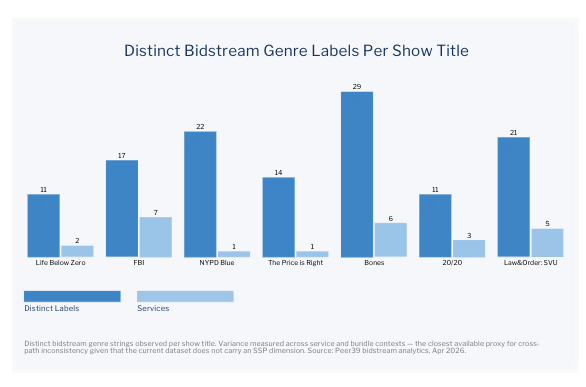
Some samples of genre mislabelling:
FBI - Thriller and Sports
The Price is Right - Sports
Bones - Action, Comedy, Sports
When buyers apply genre-based targeting across a FAST buy that spans multiple SSPs, they are frequently applying it against signals that describe the same underlying inventory in incompatible ways without visibility into the inconsistency. Filters that appear to be working consistently are often working in some paths and failing silently in others.
When program-level signals are absent, buyers adapt. The standard fallback is platform-level selection: choosing FAST services by name and treating the app label as a proxy for content quality. For the largest FAST platforms, this provides some baseline signal. It still does not describe content, it describes the container.
A single FAST platform hosts hundreds of channels, dozens of genres, and significant variation in content quality, audience engagement, and brand adjacency. Buying against the app name tells a buyer that an impression appeared somewhere within that environment. It does not tell them where, or alongside what.
Completion rate fills in next. High completion rates in FAST are common—lean-back viewing behavior drives strong video completion regardless of what’s on screen. Across genres and program types, CTV completion rates cluster tightly between 95 and 100%. Live sports and background content post nearly identical completion numbers. When buyers optimize on completion rate without supporting content signals, they are optimizing for delivery—and delivery does not distinguish between premium programming and ambient filler.
This signal gap impacts performance, pricing, and trust.
On performance: optimization algorithms fed signal-poor data will find the most efficiently priced inventory, not the best inventory. In FAST, that tends to mean concentrating spend in the cheapest, least-differentiated parts of the environment and not the parts that carry the content context that drives outcomes.
On pricing: buyers who cannot distinguish between programming environments within FAST cannot price that distinction. Authenticated program signals are more valuable than signal-less impressions from the same platform, but without the signals, buyers treat them identically. That flattens pricing in ways that create no incentive for publishers to invest in signal quality. This is the opposite of where the ecosystem needs to go.
On trust: this is where the opportunity is clearest. Program-level authenticated signals across CTV have roughly doubled over the last three months, and FAST is leading that growth. Buyers who understand the specific nature of the signal gap are positioned to access it on better terms than those who have written the category off. Those buyers understand that the content quality in FAST is there when you know where to look.
Peer39’s analysis of FAST signal coverage, including program-level signal rates, metadata consistency across supply paths, and authenticated channel data, is detailed in Getting FAST Right: A Signal-First Approach to Buying Quality FAST.

Fortune 500 Brands account for 45% of all ads observed across Fake CTV and Divisive News content channels as evidenced by Peer39's 10 week long study

Discover how Peer39's contextual intelligence tools can help agencies alleviate burnout, streamline workflows, and enhance ad performance without...

Optimize your CTV sports advertising with Peer39's precision targeting, ensuring clarity, safety, and performance in a fragmented viewing landscape....
