
2 min read

Brand Suitability vs. Safety: Why Verification Isn't Always Enough

Brand Suitability vs. Safety: Why Verification Isn't Always Enough

Why verification alone isn't brand suitability

Passing a safety check and fitting a brand's context are two different questions

Most ad verification answers one question: is this content bad? Not violent, not adult, not fraudulent. That's brand safety, and every buyer needs it. But it doesn't answer the question that actually determines whether an impression is right for a specific brand: does this environment fit what the brand is trying to say, and to whom? That's brand suitability, and a safety check alone can't answer it.

Brand safety and brand suitability aren't the same question

Brand safety is a floor. It excludes content in categories a brand has decided are always off limits, regardless of campaign: adult content, extreme violence, hate speech, illegal activity. It's binary. Content either falls into an excluded category or it doesn't.

Brand suitability is a question of fit. A financial services brand running a retirement campaign might need to avoid content about market volatility, even though a volatility headline is not unsafe by any standard definition. A children's brand might need granular exclusions around mature themes that a general safety filter doesn't distinguish from an action movie’s content rating. Suitability depends on the brand, the campaign, and the moment, not a fixed list.

Buyers who treat these as the same problem end up over-relying on a tool that was only ever built to answer the first question.

The real risk isn't bad content. It's unknown content

Peer39's benchmark data on authenticated CTV inventory shows something buyers don't expect: when program-level signal is actually present, 97% of impressions fall within standard TV ratings, and unrated content accounts for barely 1%. In other words, when the environment is genuinely visible, it's overwhelmingly professional, standard content.

The risk shows up somewhere else entirely. Roughly 60% of CTV bid requests still lack usable program-level signal, meaning buyers aren't seeing the show, genre, or channel behind the impression at all. That's not a safety failure. A safety filter can clear an impression with no program data attached just as easily as one with full data attached. It's a visibility failure, and visibility is what suitability actually depends on.

What suitability actually requires

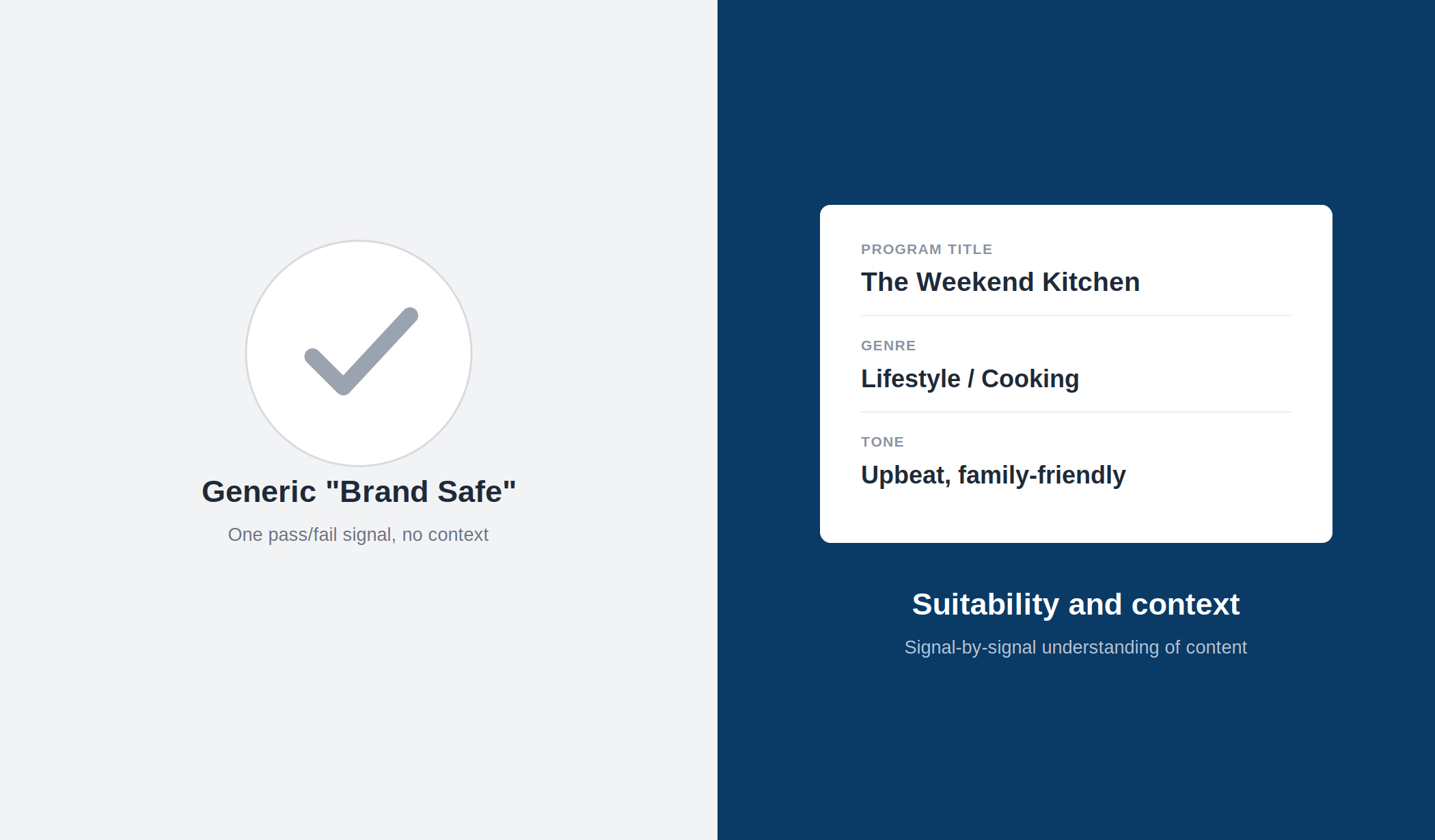
A safety flag at the domain, app, or channel level can't tell a buyer whether a specific piece of content fits a specific brand. Suitability requires signal at a much more granular level:

  • Program-level depth in CTV. Not just the app name, but the show title, genre, rating, and channel identity behind each impression.
  • URL-level granularity in display. Not just a domain-level safety score, which averages risk across every page a site publishes, but signal specific to the page running the ad.
  • Subcategory-level precision in mobile. Not an app-level category that blends a news app, a casual game, and a utility tool under one label, but classification specific to what's actually happening in that app.

Without that depth, "safe" is the only claim a verification report can make. It can't tell a buyer whether the content is right, only that it isn't obviously wrong.

The next question to ask a vendor

Before renewing or expanding a brand safety stack, ask what level of granularity it actually operates at. If the answer is domain, app, or channel, that's a safety tool. If it can show program-level, URL-level, or subcategory-level signal, that's a suitability tool.

Most buyers are paying for the first and assuming they're getting the second.


Brand suitability: Target the right content with context

2 min read

Brand suitability: Target the right content with context

This year has been intense when it comes to news coverage, especially with so much reporting around the pandemic, politics, and protests....
Read More
Peer39’s Brand Suitability and Safety Controls: How To Think About Brand Protection

1 min read

Peer39’s Brand Suitability and Safety Controls: How To Think About Brand Protection

Brand safety is not one-size-fits-all. What’s considered unsafe for a kids’ toy brand may be totally fine for a beer company. This is why Peer39...

Read More
The Real Cost of Keyword Blocking: Reach Lost, Dollars Wasted

1 min read

The Real Cost of Keyword Blocking: Reach Lost, Dollars Wasted

In the world of digital advertising, brand safety remains a paramount concern for advertisers. With the rise of programmatic advertising and the...

Read More