2 min read
What "safe, human, viewable" leaves out of ad verification
 David Simutis
:
August 24, 2026
David Simutis
:
August 24, 2026
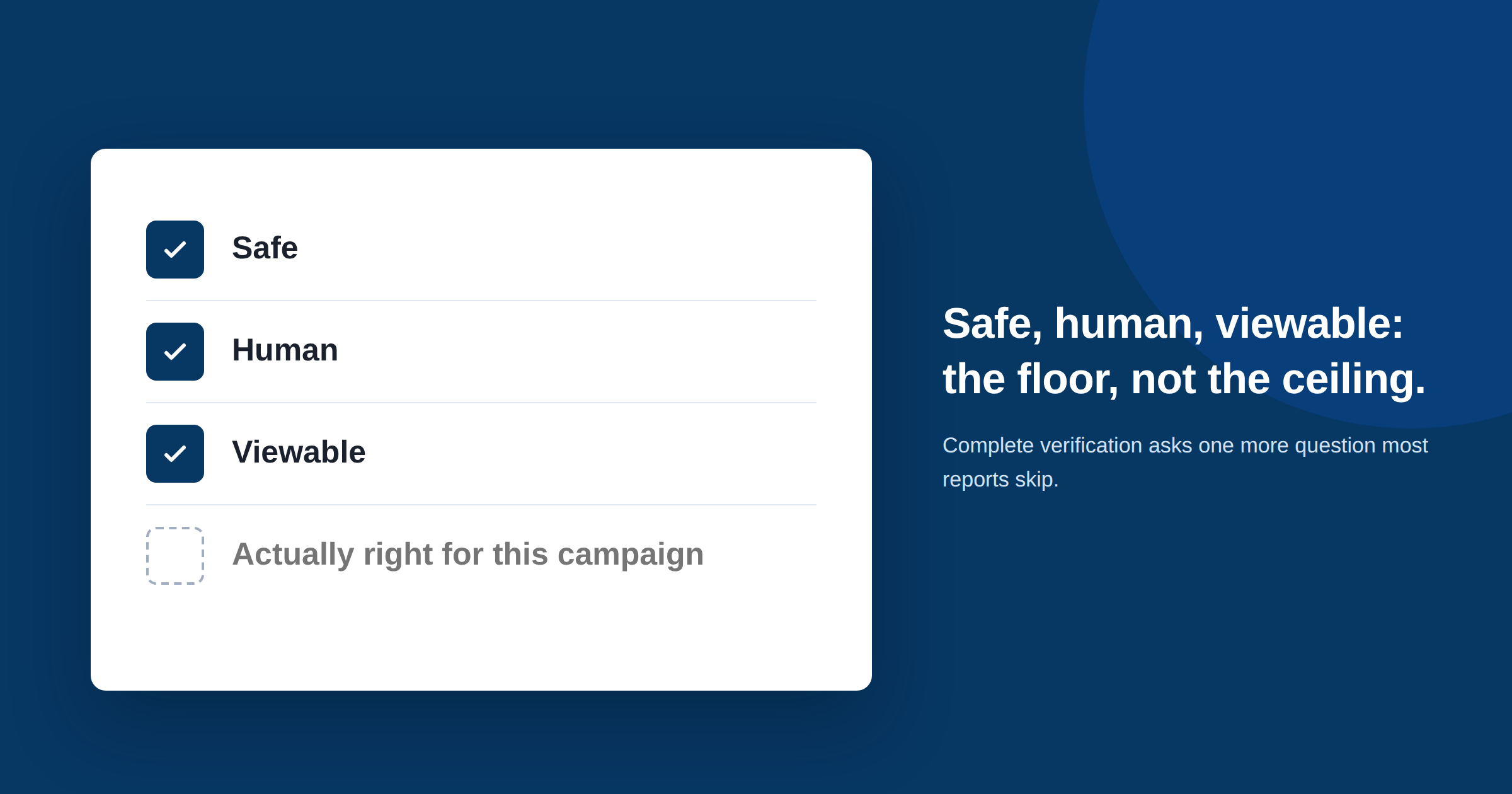
Three checkmarks confirm an impression isn't disqualified. They don't confirm it's right
Most verification reports boil down to three checkmarks: safe, human, viewable. Not a banned category, not fraudulent traffic, an ad that was actually in view. Those are the floor. Every buyer should have them. But they're not proof that an impression is worth the impression, and treating them as the finish line is where most verification stacks fall short.
Safe, human, and viewable are the floor, not the ceiling
Each of the three checks answers a narrow, binary question:
-
Safe means the content doesn't fall into an excluded category, such as violence, adult material, or hate speech.
-
Human means the traffic passed invalid traffic (IVT) and sophisticated invalid traffic (SIVT) detection, confirming a real person, not a bot, was behind the impression.
-
Viewable means the ad met a minimum in-view threshold, typically defined by the Media Rating Council.
All three are necessary. None of them describe the actual environment the ad ran in. An impression can be safe, human, and viewable, and still run against content nobody can identify.
What gets missed when verification stops there
Peer39's CTV benchmark data shows exactly how much can pass through those three checks unnoticed. Roughly 60% of CTV bid requests still lack usable program-level signal, meaning the show, genre, and channel behind the impression are effectively invisible, even when the traffic is human and the ad is viewable.
The gap shows up in the content itself, too. In open exchange environments without authenticated signal, Sensitive Content accounts for 23.2% of impressions and user-generated content for 5.33%. In campaigns using authenticated, program-level signal, those figures drop to 6.02% and 0.03%, a 4x and 177x difference. None of that gap is caused by traffic that's fraudulent or unviewable. It's caused by content that was never actually identified in the first place.
What complete verification actually requires
The cost of that overblocking doesn't stay with the buyer. It lands on the publisher, who loses demand for content that was never an issue. App-only brand safety tools can't separate a publisher's suitable programming from its unsuitable programming, so the entire app — and by extension the entire publisher relationship — absorbs a block that should have applied to a fraction of the catalog. A publisher with a strong slate of premium programming and one edgier late-night show gets treated, from a targeting standpoint, as if the whole lineup carried the same risk.
What content-level verification actually requires
Closing that gap means moving past category-level flags and into environmental signal that's specific enough to describe what's actually running:
- Program-level depth in CTV: The show title, genre, rating, and channel identity behind every impression, not just the app name the impression was bundled under.
- URL-level granularity in display: Signal specific to the page serving the ad, not a domain-wide score that averages risk across every page a publisher runs.
- Subcategory-level precision in mobile: Classification specific to what an app actually is and does, not an app-level category that groups a utility tool, a game, and a news app under one label.
This is the difference between verification that confirms an impression isn't disqualified and verification that actually describes the environment behind it.
The question that separates the two
Ask any verification vendor to show data at the program, URL, or subcategory level, not the domain, app, or channel level. If the answer stops at category flags, that report is a floor. If it can show what's actually running, it's a picture, and a picture is what buyers are actually paying for.
